Sunday, July 20, 2014

Structured Note issuance summary July 1-3 week, 2014


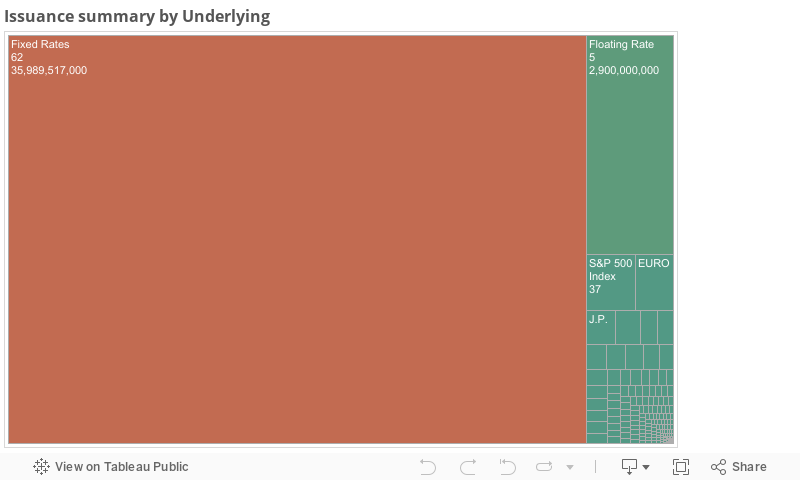
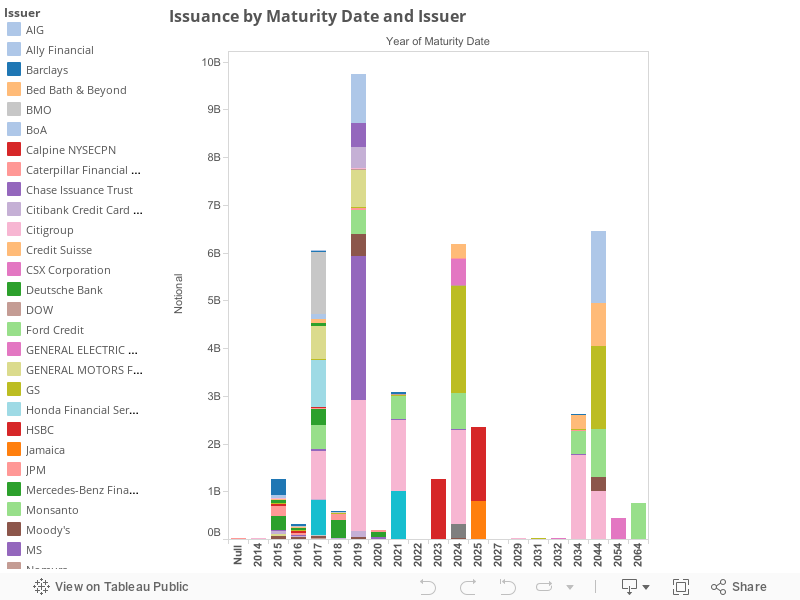
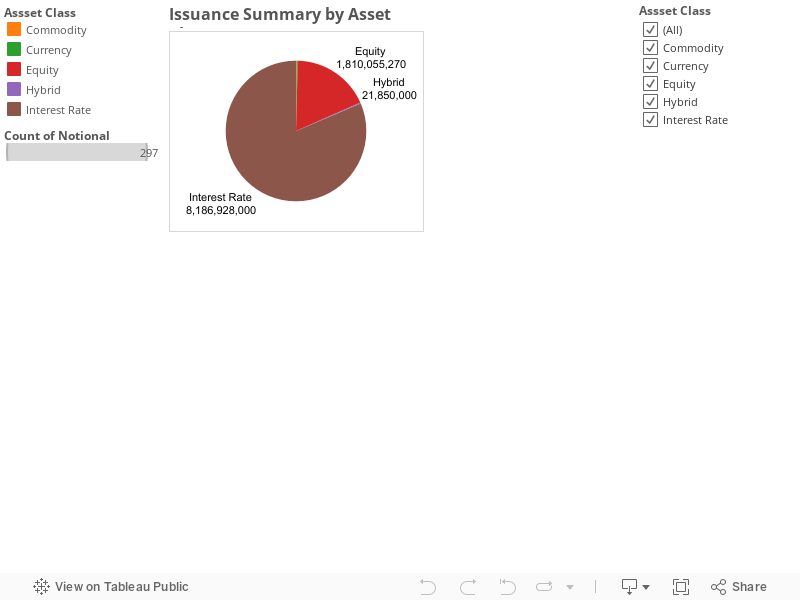
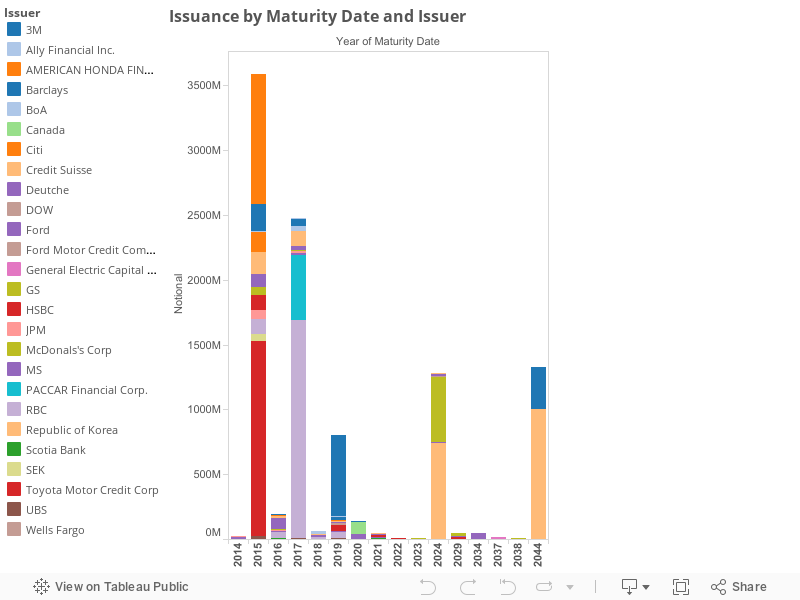
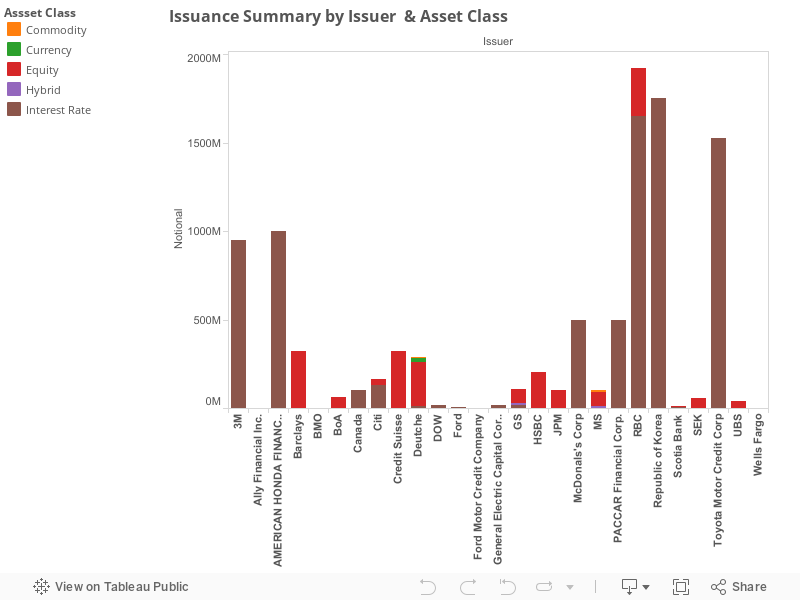
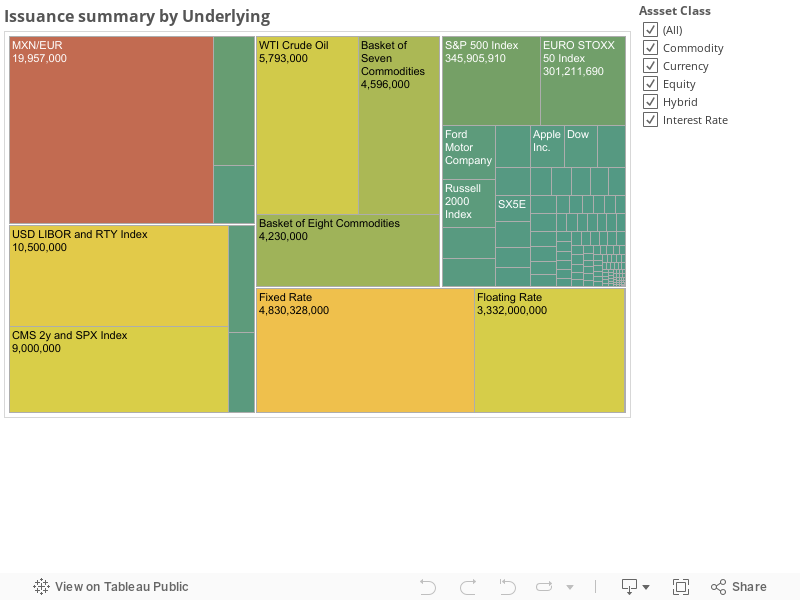
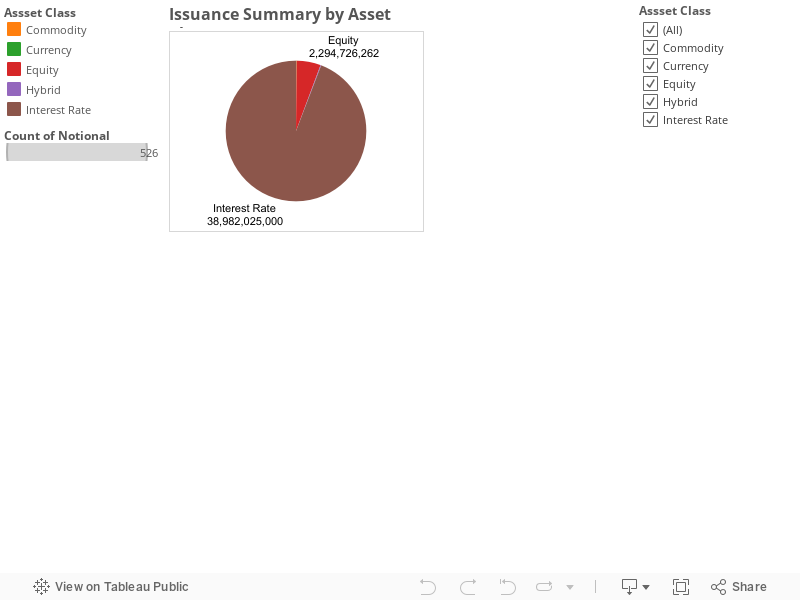
During the week of July 1-18, 2014 structured note issuance has been 41 Bn across various issuers and asset classes. Most of the issuance (2.2 Bn) is driven by Equity Linked notes and 38.1 Bn of the issuance is driven by Interest linked products. There has been some activity in commodity linked issuance this week. For Details of the distribution refer to the chart below. Not surprisingly majority of the structured note issuance is linked to Interest rate linked by few issuers.

This week, structured notes were issued with variety of flavors and interesting themes. Majority of this issuance comprised of Interest Rate related notes Read on for more details.


You can click individual asset classes to see how the underlying issuance has happened within each asset type by underlying and Issuer.


Underlying analysis

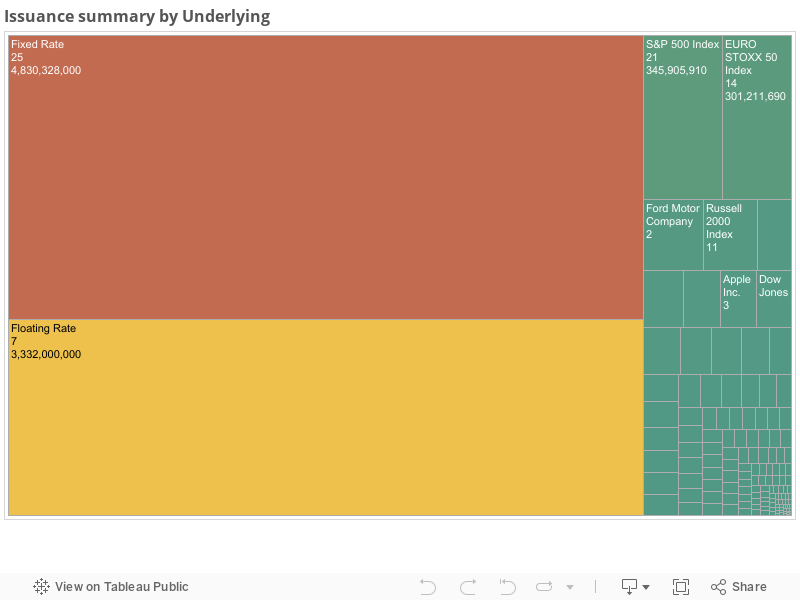
On the Equity linked notes front there has been strong activity. Notes have been created on variety of underlyings. Index related issuance has been significant. This week issuance included notes created on the indices ( S&P 500, Stoxx 50, Russell 2000) and single names ( Face Book, Amazon,Pulte Group, Apple, Yahoo and so on). There has been significant activity around basket linked notes. Looks there is high appetite from institutional investors to conduct their portfolio balancing process.

This week has been a slow week with most of the issuances taking place on Tuesday. There are a few interesting notes. The DAX Index was used as the underlying for three of them. Deutsche Bank issued a note on Delta Air Lines, Inc fortotal notional $11.9 million. One of the bigger notional was issued by J.P Morgan at $148 million on the J.P. Morgan Enhanced Beta Select Backwardation Alternative Benchmark Total Return Index. Another interesting note is by Barclays on the International Paper Company as a Synthetic Convertible Note at a notional of $41.7 million. Finally UBS used a different variation of their usual notes by issuing Phoenix AutoCallable Notes for six different companies at $500,000 each.


Interest rate linked issuance limited to standard, step up callable notes and Fixed rate notes. Activity has been subdued this week.Citigroup, RBC and AMERICAN HONDA FINANCE CORP are major issuers of these products.

This week we have seen commodity note issuance tied to Commodity Baskets and Crude Oil by Morgan Stanley..

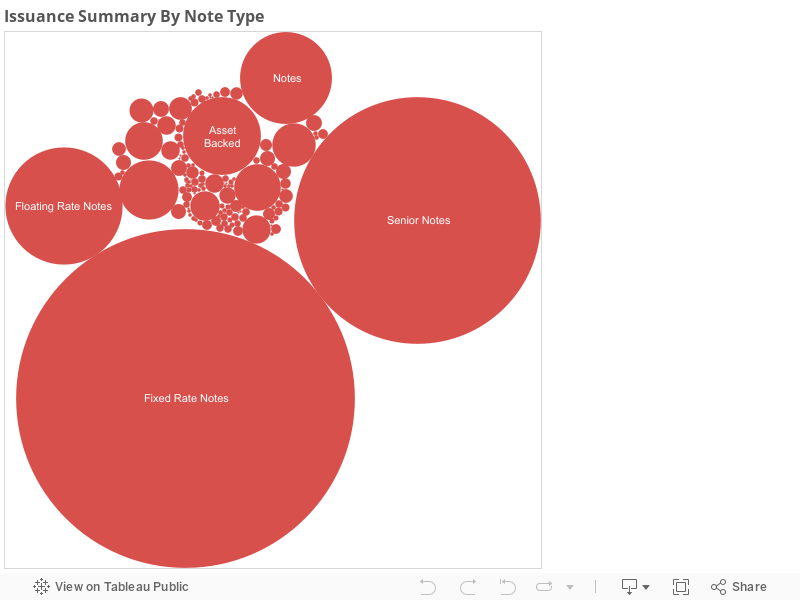
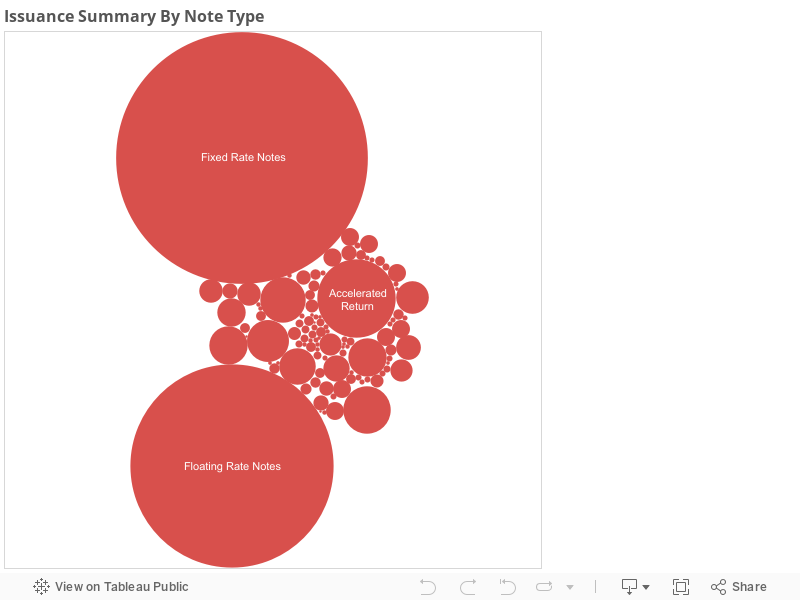
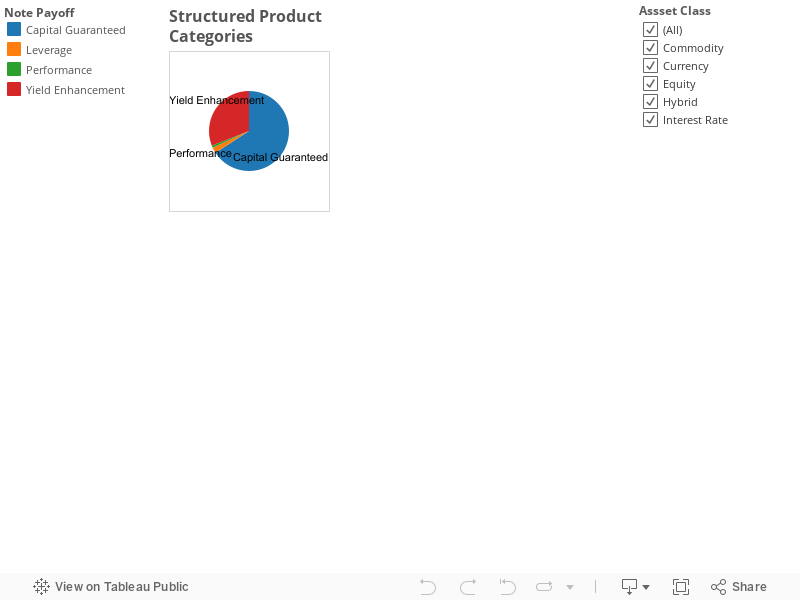
Size of the note types will tell us an indication of what type structures are popular among the investors and where money is flowing. Below chart shows this theme


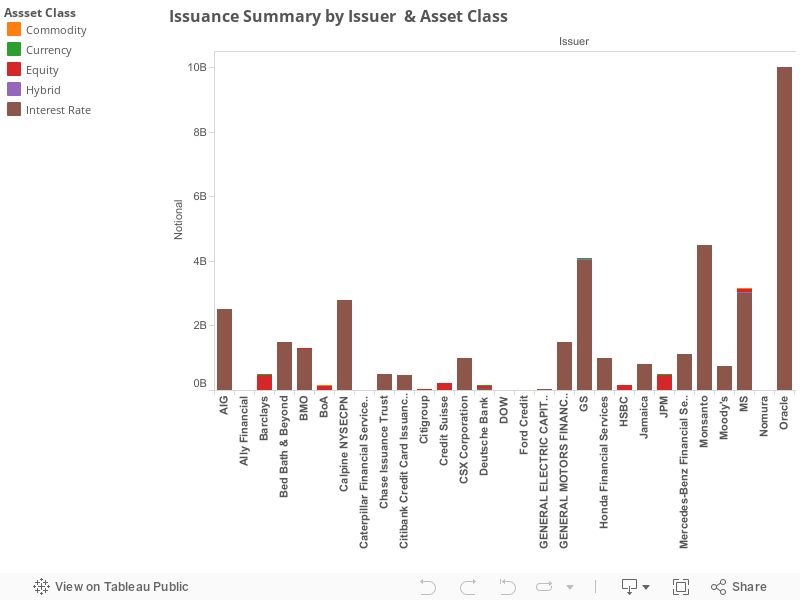
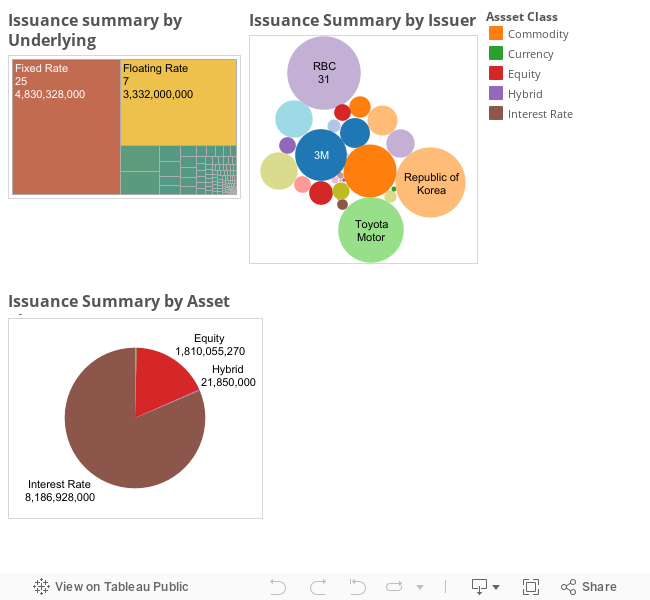
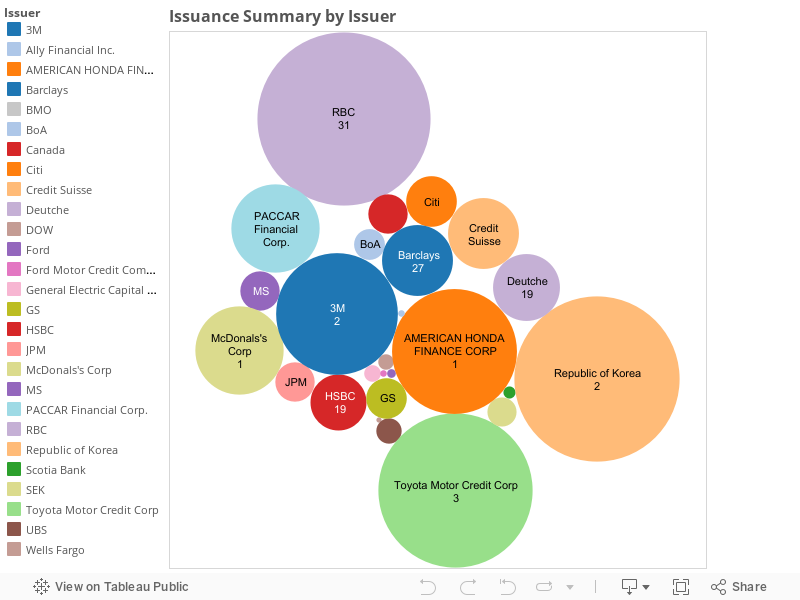
Popular notes have been interest rate linked notes. Now moving on to issuers side and understanding their market penetration or competitor analysis provides some interesting insights. This week UBS, MS, GS and Barclays captured issuance market share.


Market penetration is driven by the issuer depth in each of the asset classes. Every issuer has presence in Equity linked issuance. Goldman is only issuer to produce Currency related issuance. Morgan Stanley and JPM are active players in the Hybrid related issuance.


BRICS bank will it live upto itsexpecations?

India Financial Markets -- BRICS Bank – will it deliver as intended? We think not.
Narendra Modi in his Fortaleza speech in Brazil has delivered a strong message against terrorism and collaboration among BRIC countries.
He started of his speech with “I come from a land where the idea of the 'whole world being one family' is rooted in our ethos -Vasudhaiva Kutumbakam. “ in a very friendly manner. This statement makes me feel like he borrowed a point from Swami Vivekananda’s speech at Chicago’s World religious conference in 1893. From here he delved on his views of various geopolitical events including conflict in Syria, Iraq and Israel-Palestine. Now, looking a bit detail what is on the minds of BRICS leader when they have decided to start the BRICS bank (see full summary). They wanted a fund to help each other during the time of economic crisis. This fund will have China as majority stakeholder. This brings to the point in a world with IMF and World Bank do we need another regional group. I am in favor of having likeminded groups for prosperity. Do BRICS share similar economic and political trajectories in global setting? I do not think so. BRICS – [ Brazil – Russia – India – China – South Africa]. BRICS is an acronym coined by Goldman Sachs banker to group together growing emerging market countries. From then on financial markets looking for a narrative for market changes has borrowed this theme heavily on analyzing their investment thesis. How similar are these entities apart from being termed as big and developing countries when the name BRIC coined. Democratic form of ruling is at the core for (Brazil, India and South Africa) and diametrically opposite philosophy of autocracy prevails in (China and Russia). This kind of fundamental difference in ideology will become main hindrance at the time crisis to arrive at consensus based solutions.
China has clearly signaled to the world that it has to be taken seriously in the global scenario. Its policy of aggression with its neighbors in south china sea, cyber security issues with United states. China is net creditor to developed countries. It is ambitions are replace United States at the top of global power order and accordingly projecting its power when west is retreating. Like China, Russia under the Putin’s stewardship is living as bulwark for bullying neighboring countries. Russia hold keys to natural gas supply to the Europe and therefore it is able to take a confrontation position with west. Now other members, Brazil, India and South Africa each with their democracy framework, domestic financial issues (inflation, fiscal deficits) and corruption it higher places. BRICS group so different in everything except rising economies can be everything but a cohesive group.

Monday, July 14, 2014

Currency Note from Barclays on emerging market currency basket

Barclays has issued a note on emerging market currencies relative to Euro. Gatick Global as analyzed this note and thinks that this note is a medium risk note and investors who likes to gain exposure to emerging market currencies with little risk and unlimited upside potential.

Structured Note on Emerging Market currency basket

Friday, July 11, 2014

Structured Investment Analyzer

Gatick global solution is proud to announce our new product - Structured Investment Analyzer today. Our mission is to bring transparency and increase awareness and understanding of these structured note markets. To accomplish this task myself and my friend Karthik Misra have created research report that can be used as a tool to understand various aspects of structured note analysis like

1) Investment theme: A brief description of the investment outlining the terms of the note by describing how investors are going to be rewarded is provided. After this,clear analysis of investment opportunity is mentioned with analysis of the note underlying stock or index performance combined with option markets implied volatility analysis
2) Investment Metrics: In this section, a set of quantitative metrics, expected return, volatility, Risk Score, probability of making profit on the note are estimated using historical data and creating a Risk - Return dash board.
3) Investment Performance: In this section, note is analyzed to see if this note would have fared in historical setting and in future (stress test) scenarios. This will result in thorough understanding of what can and might happen to the structured note
4) Investment recommendation: Finally, In this section, some pros and cons of the note are discussed along with a investment score card and investment opinion by Gatick global solutions.

This kind of analysis will help Financial advisers who want to understand the product risk reward relationships and explore the possibility of employing the structured note for their clients and improve their returns and indirectly grow their businesses.

Tuesday, July 1, 2014

Swap Data Repository - Cleared Swaps and Implications

In the wake of financial crisis of 2008, we have seen huge amount of regulation to restrain Derivatives trading. Dodd Frank act started taking aim at every aspect of trading that might lead to another crisis. As a part of this act, Dealers are now required to report every OTC (over the counter) trades to Trade repositories at DTCC and Bloomberg.
This kind of real time reporting has broad implication to the financial market participants. Some of the technology firms have started taking aim at this kind of data and started organizing them. Notably, Data solution from Gatick Global provides real time market intelligence and trends.
For instance regulators or consulting teams can view the market share by product in major currencies (USD, EUR, GBP and JPY)

This will tell them which product is trading more on the market and how much volume is outstanding.
Next if you want to see if market players are trading bilaterally or on the Swap exchange facilities, once can look at the chart pertaining to

Most importantly, if you want to know what trade has been done at what maturity and what level it got cleared just try this link
http://derivdata.gatick.com/transaction-data-visualizations/usd-swaps/
This will give you a view of the market flow which is key to any trading activity.
Now you can say, alright, I know product trends, that which product has larger share and product clearing levels that is which product is trading at what price. You can look at the real time market Yield curves, volatility surfaces that are just available to only few players. Gatick Global provides market data generated from Transaction prices.
http://derivdata.gatick.com/usd-yield-curve/

So think of a situation when, you have access to real time, transaction prices, underlying yield curves and volume trends at your press of enter key. all You have to worry then is to use this see clearly which direction market is trending.
with best regards
chandra

Monday, June 30, 2014

Facts around Structured Notes Usage - Advisor's perspective survey

US SEC registered market is about 45-60 bn in size. Internationally this market is much bigger owing to matured market in Europe and active investor demand in Asia and Latin America. These products are becoming important risk management tools in investor’s portfolios. They provide access to variety of markets where ETF’s or other products cannot reach by providing partial to full protection to capital. Despite these virtues, market participants complain about their complexity, illiquidity and transparency.
Recently Exceed Investments found after surveying 700 financial advisors that structural inefficiencies like, Illiquidity and transparency are holding back the latent demand for structured investors. “Exceed Investments is a New York-based financial services firm developing next-generation structured investments. The firm commissioned a third party to conduct studies on structured investment perceptions in both 2013 and 2014, culminating in the proprietary 2014 Exceed Structured Investments Report. The goal of the research was to identify overall advisor views on and usage of structured products, with an eye towards identifying which steps the industry can take to increase utilization and acceptance.”
Research methodology • Research leadership – WealthManagement.com, a Penton Media company • Participants – 707 completed advisor surveys • Participant selection – Members of the Wealthmanagement.com database; random selection • Motivation – Participation led to eligibility in a lottery for several American Express gift cards
Why do we use structured notes?
Today investing world is replete with variety of investment options including derivative products. Commonly asked question is if I need exposure to a particular asset I can invest in that asset directly by buying a stock, or mutual fund or an ETF. Even I can create such a product sometimes using Options on those assets. All of these are true to certain extent. But like the name structured notes provide customized risk and reward profiles.
For instance, Yesterday I was discussing with a friend of mine about a Reverse Convetible note issued by a large bank is good investment or not. He immediately fired back, what is the return on the note. I told him 6% per annum for 6 years in this low interest environment. Compare this to US Treasuries that offer mere 2%. Next question came to me what is my risk. To this I said, if the index underlying Reverse Convertible goes below 50% of the initial index level on the maturity date you will lose corresponding capital otherwise you will get full return of capital. Now this kind of note can be deployed by understanding the Risk/reward metrics both historically and in probable future scenarios.
Below survey of Advisors speaks exactly to this fact that people want to use structured notes by understanding the Risk and Reward of these products.

Next question comes to mind is okay, you need structured notes but what features are most desirable. During my same discussion about the structured investments yesterday, another friend told me people are afraid of repeat of 2008 scenario. That is they want protection from secular decline in the market. This has been captured clearly by the Exceed investments survey on desirable features below. Most of the investors are looking for capital protection.

Alright, we know now some of the motivations behind the need for a structured investment. Then are these products being used more often or less often? Not surprisingly they are being use less as per survey below and my informal conversations. Most investors who lost their money investing in these products have considered moving away from them and some other have not understood these products so they do not have any interest.

We see in this chart, that structured notes are being used in very small portions despite their benefits. I guess this is so because of limited information about these products.

Now that we have looked at why structured notes are preferred and still not part of the overall portfolios. Let us take a look at some drivers for avoiding these products. Below survey speaks loud and clear these products are too complicated to understand and they tend to be highly illiquid. On the point of being too complicated I agree to some extent only. I agree products with strange names like Air Bag auto callable, Trigger phoenix autocallables, high low range accrual etc might confound an ordinary investor. I would think for an investor who is adept at handling latest mobile phone gadgets and navigating through them in 21st century spending some time to understand these products is time well spent. On the point of illiquidity, I think more people start holding these products market will start building its own secondary market.

I am a strong advocate of transparency around, the information on the structured note issuance, their market values and understanding of the underlying derivatives. Now as more and more people start understanding these products and associated risks and rewards we think market will improve. As you are witnessing in the Over the Counter derivatives markets, after moving the transactions to Swap exchange facilities and cleared space we are seeing spreads becoming narrower. This is natural consequence of the opening up markets. One important thing I found interesting in the survey is to reduce the minimum size. Now many issuers are currently coming up with products with small unit sizes.

Another important facet in the structured note business is distribution channel. Most of the distribution is being conducted via Wirehouses

If you are provided access to these structured products so that you can possibly help your investing clients benefit from these products. Most of them are still in the state of confusion rather than jump onto investing in the structured notes. This clearly indicates, Access to markets, understanding of the markets are both required to fully realize benefits of this market I am actively advocating for transparency in the structured note markets through products like, Structured note database to what is on the market, Independent pricing to discover the market values and training and education to understand these markets better.
Monday, June 16, 2014

Structured Note Issuance summary June 1-13-2014


During the week of June 1-13, 2014 structured note issuance has been 10 Bn across various issuers and asset classes. Most of the issuance (1.8 Bn) is driven by Equity Linked notes and 8.1 Bn of the issuance is driven by Interest linked products. There has been some activity in commodity linked issuance this week. For Details of the distribution refer to the chart below. Not surprisingly majority of the structured note issuance is linked to Interest rate linked by few issuers.

This week, structured notes were issued with variety of flavors and interesting themes. Majority of this issuance comprised of Interest Rate related notes Read on for more details.


You can click individual asset classes to see how the underlying issuance has happened within each asset type by underlying and Issuer.


Underlying analysis

On the Equity linked notes front there has been strong activity. Notes have been created on variety of underlyings. Index related issuance has been significant. This week issuance included notes created on the indices ( S&P 500, Stoxx 50, Russell 2000) and single names ( Face Book, Amazon,Pulte Group, Apple, Yahoo and so on). There has been significant activity around basket linked notes. Looks there is high appetite from institutional investors to conduct their portfolio balancing process.

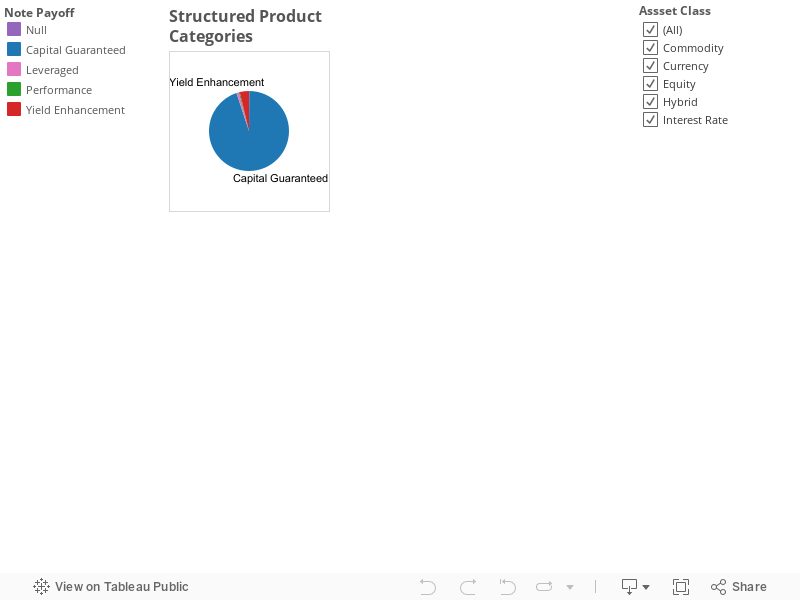
Notable notes this week were tied to SPX Index (144 MM) issued by Credit Suisse. This note belongs to the class of Leveraged Note type. CS created a note 22545F466with a size of 144 MM paying three times Market performance at maturity date (07/31/15) with a coupon capped at 10% and as long as index is above initial level. On the downside this note is exposed to one to one downside underlying performance. Motivation behind participating in this kind of note is to obtain 3 times leverage on the coupon. Another interesting note is on Ford Motor company stock. This looks very high notional for a stock like Ford Mortor company 40434C543 This note belongs to Yield enhancement type and providing a 7% quarterly coupon.


Interest rate linked issuance limited to standard, step up callable notes and Fixed rate notes. Activity has been subdued this week.Citigroup, RBC and AMERICAN HONDA FINANCE CORP are major issuers of these products.

This week we have seen commodity note issuance tied to Commodity Baskets and Crude Oil by Morgan Stanley..

Size of the note types will tell us an indication of what type structures are popular among the investors and where money is flowing. Below chart shows this theme


Popular notes have been interest rate linked notes. Now moving on to issuers side and understanding their market penetration or competitor analysis provides some interesting insights. This week UBS, MS, GS and Barclays captured issuance market share.


Market penetration is driven by the issuer depth in each of the asset classes. Every issuer has presence in Equity linked issuance. Goldman is only issuer to produce Currency related issuance. Morgan Stanley and JPM are active players in the Hybrid related issuance.